In short
Epoxy mortar is a rigid flooring system in which a high proportion of quartz or corundum aggregate is mixed with epoxy resin to a mortar consistency and laid at 4–9 mm and above, offering the highest compressive, impact and chemical resistance available. It is chosen for food and beverage factories, chemical and petrochemical plants, cold stores, heavy industry and the repair of damaged concrete floors.
Also known as: epoxy screed · epoxy trowel mortar · heavy-duty epoxy flooring · epoxy repair mortar
What is it?
What is Epoxy Mortar Flooring?
Epoxy mortar is a rigid flooring system in which quartz or corundum aggregate is blended in high proportion with epoxy resin and laid at 4–9 mm or more. It is designed for industrial floor repair and high-performance protection.
The epoxy mortar system is prepared by adding a high proportion of quartz or corundum aggregate to a two-component epoxy resin, producing a floor that meets the most demanding industrial requirements. Because it offers far higher compressive, impact and chemical resistance than standard self-leveling or textured systems, it is the first choice for food factories, chemical plants and heavy industry. Applied at 4–9 mm or more, epoxy mortar is also highly effective for repairing damaged concrete floors with cracks and voids. Surface texture and slip resistance can be tailored to the project specification. Zeminsan Epoksi delivers every epoxy mortar installation to the highest standards, using European resins and a certified crew.
This system is part of the Epoxy Floor Coating family; you can compare it with the others in the table below.
System Types and Variants
- Epoxy mortar (standard)
- 4–6 mm; heavy traffic and chemical resistance.
- High-build mortar
- 9 mm+; levelling and repair, machine bases.
- Chemically resistant (novolac) mortar
- Acid and alkali intensive plants, battery and galvanising areas.
- Slip-textured mortar
- Wet food processing areas, R11–R12.
How Is It Applied? The Stages
- 1. Surface preparationDeep profiling by shot-blasting; damaged concrete is broken out and removed; moisture tested.
- 2. Epoxy primerA primer applied so the mortar can be laid wet-on-wet.
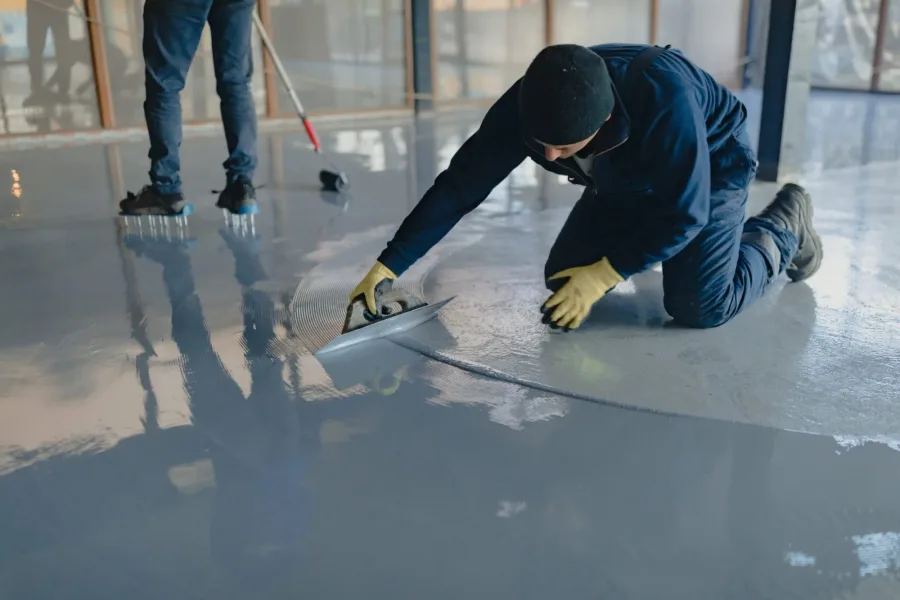
- 3. Laying the mortarThe epoxy and aggregate mortar is laid with a trowel or power float, compacted and levelled; 4–9+ mm.
- 4. Seal coatA pigmented epoxy that closes the pores, in the required texture (smooth or slip resistant).
- 5. CuringFoot traffic after 48 hours, vehicles after 72 hours, full chemical and mechanical load after 7 days.
Technical Specifications
Where It Is Used
- Food processing and beverage factories
- Chemical and petrochemical plants
- Cold stores and refrigerated areas
- Heavy industry and steel plants
- Vehicle manufacturing and automotive plants
- Repair of damaged concrete floors
Advantages
- 01 The highest compressive and impact resistance
- 02 Outstanding protection against aggressive chemicals
- 03 Can be used to repair damaged concrete
- 04 Surface texture and slip class can be specified
- 05 A long-life investment with low maintenance cost
Drawbacks and Limitations
- It is the thickest and most labour-intensive system; cost per m² is above self-leveling.
- It is rigid; for thermal shock (hot water or steam washing above 60 °C) polyurethane-cement is more suitable.
- Application and curing take longer; the space needs to be closed for 3–7 days.
When Should You Choose It?
Choose it when
- Heavy impact, steel-wheeled traffic and high point loads
- Contact with aggressive chemicals, acids, oils and salts
- Permanent repair of pitted, broken or degraded concrete floors
- Food, chemical, cold storage and heavy industry
Consider another system
- Clean areas with light to medium traffic → self-leveling
- Budget-driven protection → epoxy paint
- Continuous steam cleaning → PU mortar
Epoxy Flooring Systems Compared
| System | Thickness | Service life | Traffic | Slip resistance | Best for |
|---|---|---|---|---|---|
| Epoxy Paint / Coating | 0.3 – 0.6 mm | 5 – 8 years | Light – medium | Smooth (R9–R10 with additive) | Garages, warehouses, workshops, dust-proofing |
| Self-Leveling Epoxy | 2 – 3 mm | 10 – 15 years | Medium – heavy foot, light vehicle | Smooth (R9–R10 with additive) | Hospitals, offices, food plants, retail |
| Textured (Multilayer) | 4 – 8 mm | 15 – 20 years | Heavy — forklift, truck | R11 – R12 | Factories, warehouses, ramps, wet areas |
| Epoxy Mortar | 4 – 9+ mm | 15 – 25 years | Very heavy, impact | R10 – R12 (texture dependent) | Food/chemical plants, concrete repair |
| Anti-Static / ESD Epoxy | 2 – 3 mm | 10 – 15 years | Medium | Smooth | Electronics, data centres, operating theatres |
| Metallic Epoxy | 2 – 3 mm | 8 – 12 years | Foot, light commercial | Smooth (gloss) | Showrooms, lobbies, villas, cafés |
| Stone Carpet | 8 – 15 mm | 8 – 12 years | Foot, light vehicle | R11 – R12 | Outdoors: gardens, terraces, poolsides |
Alternative Systems
- Textured epoxy
- Where there is forklift traffic but no heavy impact or concrete repair.
- Polyurethane-cement (PU mortar)
- For food plants with thermal shock and steam cleaning.
- Levelling screed + epoxy
- Where the only issue is level difference.
What Drives the Price
- Thickness (4 / 6 / 9+ mm) and aggregate type
- Volume of concrete repair and levelling
- Chemical resistance class (standard / novolac)
- Seal coat and slip resistance class
- Area and access conditions
Epoxy Mortar: 1.600 – 2.800 ₺/m²
Epoxy Floor Coating Prices →
A firm price per m² is given only after a free site survey, based on the condition of the slab and the system chosen.
Relevant Standards and Technical References
- EN 13813 (SR)
- EN 1504-3 (structural and non-structural repair mortars)
- EN 12190 (compressive strength)
- DIN 51130 (slip resistance)
Technical data sheets (TDS) and certificates of conformity for the products used are provided at quotation stage.
Warranty
Zeminsan Epoksi provides a 5-year written warranty covering both labour and materials on Epoxy Mortar Flooring. The scope of the warranty (blistering, delamination, loss of adhesion) and the maintenance conditions are set out explicitly in the contract.