In short
Epoxy floor coating is the application of a two-component epoxy resin (resin + hardener) over concrete to create a seamless, easy-to-clean surface with high chemical and mechanical resistance. It suits any space that needs hygiene, durability or a distinctive look — from factories and warehouses to hospitals, food plants, car parks, showrooms and homes. The right system (paint, self-leveling, textured, mortar, anti-static, metallic) is chosen according to the load and the way the space is used.
Also known as: epoxy flooring · epoxy floor · resin flooring · industrial floor coating · epoxy floor screed
What is it?
What is Epoxy Floor Coating?
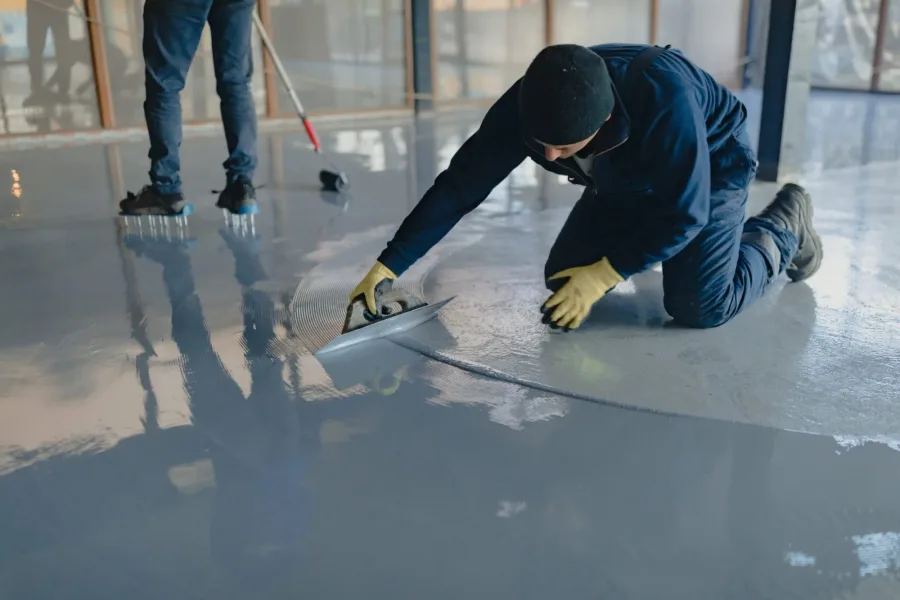
Epoxy floor coating is the application of a two-component epoxy resin over a concrete slab to form a seamless layer with high chemical and mechanical resistance that is easy to clean. The system — epoxy paint, self-leveling, textured, mortar, anti-static or metallic — is selected according to the load and purpose of the space.
With over ten years of experience, Zeminsan Epoksi has delivered epoxy flooring on more than 500 projects across all seven regions of Türkiye from its base in Istanbul. This page brings together the types of epoxy flooring system, which system suits which environment, the application steps, the factors that drive price, and the questions we are asked most often. Every sub-system has its own detailed service page and supporting guides, linked below.
Types of Epoxy Floor Coating
- Epoxy paint (coating)
- 0.3–0.6 mm roller-applied; the most economical system, for dust-proofing and light protection.
- Self-leveling epoxy
- 2–3 mm self-spreading pour; a smooth, seamless, hygienic surface.
- Textured / multilayer (quartz) epoxy
- 4–8 mm multi-layer build with broadcast aggregate; slip-resistant and built for heavy traffic.
- Epoxy mortar
- 4–9+ mm epoxy-aggregate screed; the highest compressive, impact and chemical resistance, and concrete repair.
- Anti-static / ESD epoxy
- Conductive additives giving 10⁴–10⁶ Ω surface resistance; discharges static electricity safely.
- Metallic and decorative epoxy
- Metallic pigment, flake, 3D or clear systems for spaces where appearance leads.
- Stone carpet
- Natural stone bound in clear resin; a water-permeable, slip-resistant outdoor surface (polyurethane-bound rather than epoxy).
How Is It Applied? The Stages
- 1. Site survey and slab assessmentWe measure the moisture content of the existing concrete (CM test, target < 4%), its compressive strength, cracks and voids, and the service load — then recommend a system and thickness.
- 2. Surface preparationThe surface is opened up by diamond grinding or shot-blasting; oil, dust and laitance are removed and cracks and voids repaired with epoxy mortar. Eighty per cent of adhesion is decided at this stage.
- 3. PrimerA low-viscosity epoxy primer penetrates the pores of the concrete, stops dusting and bonds the layers above. Where moisture is high, a moisture-barrier primer is used.
- 4. Intermediate / build coatDepending on the system, this is a self-leveling pour, a broadcast of quartz (textured) or a mortar screed; the required thickness and texture are formed in this layer.
- 5. Top coatA pigmented epoxy or a UV-stable polyurethane / polyaspartic top coat completes the colour, gloss level and chemical resistance.
- 6. Curing and handoverFoot traffic after 24–48 hours, vehicles after 48–72 hours, full chemical and mechanical resistance after 7 days. Quality checks are carried out and the written warranty is issued.
Technical Specifications
Where It Is Used
- Factories, production and heavy industry plants
- Warehouses, logistics centres and cold stores
- Hospitals, clinics, laboratories and pharmaceutical facilities
- Food and beverage production areas, industrial kitchens
- Car parks, garages and automotive workshops
- Offices, showrooms, retail, hotels and homes
Advantages
- 01 Seamless, hygienic surface that is easy to clean
- 02 High resistance to chemicals, oil and abrasion
- 03 A system to suit every budget and load class
- 04 Fast application, back in use within 24–72 hours
- 05 Wide choice of colour, texture and slip resistance
- 06 Repairs the existing concrete and extends its life
Drawbacks and Limitations
- On damp or poorly prepared concrete it can blister and delaminate; above 4% moisture a moisture barrier is essential.
- Standard epoxy yellows under UV over time; outdoors and in sunlit interiors a polyurethane or polyaspartic top coat is required.
- Smooth gloss surfaces become slippery when wet; wet areas need a slip-resistant additive or a textured system.
- The space must be out of use for 2–7 days during the works.
- It is a rigid system; if the concrete beneath moves (movement joints, green concrete) the crack can telegraph through to the surface.
When Should You Choose It?
Choose it when
- When a seamless, easy-to-clean and hygienic floor is required (food, healthcare, pharmaceutical).
- Where there is forklift, pallet and heavy load traffic (factories, warehouses, logistics).
- In areas exposed to chemicals, oil or salt (car parks, chemical plants, automotive workshops).
- When a dusting concrete floor needs economical protection.
- When a distinctive, modern look is wanted in showrooms, offices or villas.
Consider another system
- If the concrete has not completed its 28-day cure, or moisture is persistently high — resolve the moisture first.
- On very flexible or moving substrates such as timber decking — consider a flexible polyurethane system instead.
- Outdoors in constant direct sunlight, choose polyurethane, polyaspartic or stone carpet rather than standard epoxy.
- Where there is severe thermal shock (continuously above 60 °C) or steam cleaning, a polyurethane-cement (PU mortar) system is the right answer.
Epoxy Flooring Systems Compared
| System | Thickness | Service life | Traffic | Slip resistance | Best for |
|---|---|---|---|---|---|
| Epoxy Paint / Coating | 0.3 – 0.6 mm | 5 – 8 years | Light – medium | Smooth (R9–R10 with additive) | Garages, warehouses, workshops, dust-proofing |
| Self-Leveling Epoxy | 2 – 3 mm | 10 – 15 years | Medium – heavy foot, light vehicle | Smooth (R9–R10 with additive) | Hospitals, offices, food plants, retail |
| Textured (Multilayer) | 4 – 8 mm | 15 – 20 years | Heavy — forklift, truck | R11 – R12 | Factories, warehouses, ramps, wet areas |
| Epoxy Mortar | 4 – 9+ mm | 15 – 25 years | Very heavy, impact | R10 – R12 (texture dependent) | Food/chemical plants, concrete repair |
| Anti-Static / ESD Epoxy | 2 – 3 mm | 10 – 15 years | Medium | Smooth | Electronics, data centres, operating theatres |
| Metallic Epoxy | 2 – 3 mm | 8 – 12 years | Foot, light commercial | Smooth (gloss) | Showrooms, lobbies, villas, cafés |
| Stone Carpet | 8 – 15 mm | 8 – 12 years | Foot, light vehicle | R11 – R12 | Outdoors: gardens, terraces, poolsides |
Alternative Systems
- Polyurethane flooring
- Where flexibility and thermal shock resistance are needed; more elastic and less brittle than epoxy.
- Polyaspartic coating
- Where fast cure (same-day return to service) and UV stability are needed; higher cost.
- Concrete hardening / polishing
- Where only dust-proofing and a light sheen are needed; offers no chemical protection.
- Ceramic tile
- For low-budget residential areas; the joints are a drawback for hygiene and forklift traffic.
- PVC / vinyl flooring
- Where acoustic insulation, underfoot comfort and fast installation come first; suited to lightly trafficked offices, schools and healthcare areas. In industrial spaces epoxy is preferred because vinyl is jointed and less chemically resistant.
What Drives the Price
- System type and thickness (paint < self-leveling < textured < mortar; decorative systems cost more because of the labour)
- Surface preparation required (grinding / shot-blasting, crack repair, removal of old coatings, moisture barrier)
- Size and geometry of the area (cost per m² falls on large open floors and rises on small, subdivided ones)
- Extras: slip-resistant additive, conductive layer, antibacterial additive, UV-stable top coat, line marking
- Number of coats, complexity of colour and pattern, skirting and edge details
- Location, access, out-of-hours working and how long the space must be closed
350 – 2.800 ₺/m²
Epoxy Floor Coating Prices →
A firm price per m² is given only after a free site survey, based on the condition of the slab and the system chosen.
Relevant Standards and Technical References
- EN 13813 — Screed material and floor screeds (synthetic resin screeds, SR class)
- EN 1504 — Protection and repair of concrete structures (surface protection systems)
- DIN 51130 / DIN 51097 — Slip resistance classes (R9–R13, A/B/C)
- EN 61340-5-1 — Electrostatic protected areas (anti-static floors)
- EN ISO 2409 / ASTM D4541 — Adhesion (pull-off) testing
Technical data sheets (TDS) and certificates of conformity for the products used are provided at quotation stage.
Warranty
Zeminsan Epoksi provides a 5-year written warranty covering both labour and materials on Epoxy Floor Coating. The scope of the warranty (blistering, delamination, loss of adhesion) and the maintenance conditions are set out explicitly in the contract.