In short
Epoxy paint (coating) is a two-component thin-film epoxy system applied to concrete by roller or brush at 0.3–0.6 mm. It stops dusting, provides light chemical and moisture protection, and is the lowest-cost epoxy solution — suited to lightly and moderately trafficked areas such as garages, workshops, warehouses, basements and plant rooms.
Also known as: epoxy floor paint · epoxy concrete paint · thin-film epoxy · epoxy coating
What is it?
What is Epoxy Paint Coating?
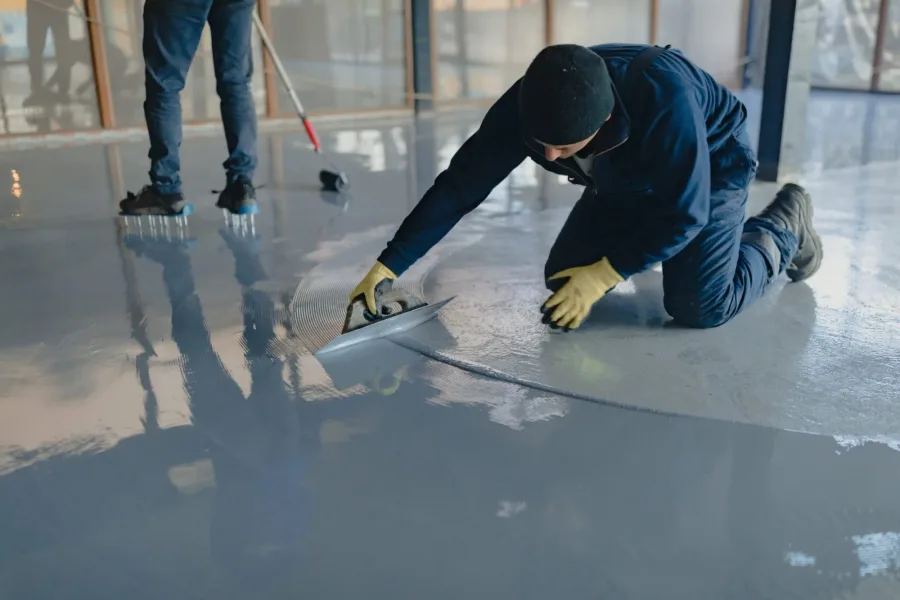
Epoxy paint coating is a thin-film epoxy system applied by roller or brush over an existing concrete or screeded floor. Its low cost and quick application make it an economical way to refurbish and protect a floor.
Applied at 0.3 to 0.6 mm, epoxy paint coating is used to stop concrete dusting, provide light chemical protection and improve appearance. Once the two-component epoxy has cured it forms a hard surface that is easy to clean and stands up to light traffic. It is the ideal choice where a fast, economical solution is needed in warehouses, garages, workshops and light commercial spaces.
This system is part of the Epoxy Floor Coating family; you can compare it with the others in the table below.
System Types and Variants
- Solvent-based epoxy paint
- Deep penetration and good adhesion; requires good ventilation.
- Water-based epoxy paint
- Low odour and VOC; preferred indoors and in enclosed spaces.
- Solvent-free (100% solids) epoxy
- A thicker film and higher durability; a higher price.
- Slip-resistant epoxy paint
- For ramps and garage entrances.
How Is It Applied? The Stages
- 1. Surface preparationGrinding or acid etching; removal of oil and dust; crack filling.
- 2. PrimerA thinned epoxy primer stops dusting and secures adhesion.
- 3. First coat of epoxy paintRoller-applied at 150–250 g/m²; cures in 12–24 hours.
- 4. Second coat of epoxy paintA second coat at right angles to the first; quartz or sand can be added where slip resistance is required.
- 5. CuringFoot traffic after 24 hours, vehicles after 48–72 hours.
Technical Specifications
Where It Is Used
- Indoor car parks and garages
- Workshops and small production areas
- Warehouses and ancillary plant rooms
- Basements and service areas
- Light commercial office floors
- Sports facility plant areas
Advantages
- 01 Low application cost
- 02 Fast to apply, minimal downtime
- 03 Stops concrete dusting
- 04 Light chemical and moisture protection
- 05 Wide range of colours
Drawbacks and Limitations
- Because it is a thin film its life is 5–8 years; under heavy traffic it will abrade and scratch.
- There is a risk of hot-tire pickup; a quality system and a full cure are essential.
- It is not suitable for heavy forklift traffic or chemically intensive areas.
- It can yellow under UV and is not suitable for outdoor use.
When Should You Choose It?
Choose it when
- Where the budget is limited and a fast, clean solution is needed
- Where the aim is to stop dusting and make the floor easy to clean
- Garages, workshops, warehouses, basements and plant rooms
Consider another system
- Forklift or heavy vehicle traffic → textured epoxy
- Hygiene and a seamless smooth surface → self-leveling
- Chemically intensive areas → epoxy mortar
Epoxy Flooring Systems Compared
| System | Thickness | Service life | Traffic | Slip resistance | Best for |
|---|---|---|---|---|---|
| Epoxy Paint / Coating | 0.3 – 0.6 mm | 5 – 8 years | Light – medium | Smooth (R9–R10 with additive) | Garages, warehouses, workshops, dust-proofing |
| Self-Leveling Epoxy | 2 – 3 mm | 10 – 15 years | Medium – heavy foot, light vehicle | Smooth (R9–R10 with additive) | Hospitals, offices, food plants, retail |
| Textured (Multilayer) | 4 – 8 mm | 15 – 20 years | Heavy — forklift, truck | R11 – R12 | Factories, warehouses, ramps, wet areas |
| Epoxy Mortar | 4 – 9+ mm | 15 – 25 years | Very heavy, impact | R10 – R12 (texture dependent) | Food/chemical plants, concrete repair |
| Anti-Static / ESD Epoxy | 2 – 3 mm | 10 – 15 years | Medium | Smooth | Electronics, data centres, operating theatres |
| Metallic Epoxy | 2 – 3 mm | 8 – 12 years | Foot, light commercial | Smooth (gloss) | Showrooms, lobbies, villas, cafés |
| Stone Carpet | 8 – 15 mm | 8 – 12 years | Foot, light vehicle | R11 – R12 | Outdoors: gardens, terraces, poolsides |
Alternative Systems
- Self-leveling epoxy
- Where longer life and a smooth appearance are wanted.
- Concrete hardener / polish
- Where dusting is the only problem and colour is not required.
- Polyaspartic coating
- Where a garage needs hot-tire resistance and same-day return to use.
What Drives the Price
- Number of coats and paint type (water-based / solvent / solvent-free)
- Method of surface preparation
- Size of the area
- Slip-resistant additive and colour
Epoxy Paint Coating: 350 – 750 ₺/m²
Epoxy Floor Coating Prices →
A firm price per m² is given only after a free site survey, based on the condition of the slab and the system chosen.
Relevant Standards and Technical References
- EN 1504-2 (surface protection)
- EN ISO 2409 (cross-cut adhesion)
Technical data sheets (TDS) and certificates of conformity for the products used are provided at quotation stage.
Warranty
Zeminsan Epoksi provides a 5-year written warranty covering both labour and materials on Epoxy Paint Coating. The scope of the warranty (blistering, delamination, loss of adhesion) and the maintenance conditions are set out explicitly in the contract.